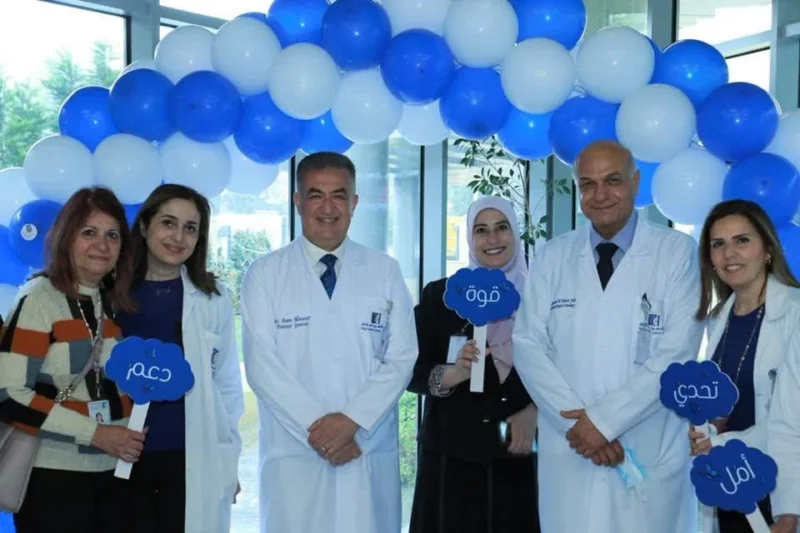
د. عاصم منصور يتحدث عن الأنظمة والثقة والإنصاف في رعاية مرضى السرطان
Asem Mansour on Systems, Trust, and Cancer Care Equity

المصدر : https://okathjordan.com/?p=160899
عكاظ الاخبارية
في لقاء خاص مع منصّة OncoDaily ،يتناول الدكتور عاصم منصور، الرئيس التنفيذي والمدير العام لمركز الحسين للسرطان.
أهمية بناء أنظمة صحية قوية، تعزيز الثقة، وتحقيق العدالة في رعاية مرضى السرطان.
حوار يؤكد أن التقدّم في مواجهة السرطان يبدأ برؤية شاملة،ويستمر بالتزام يضع المريض في قلب كل قرار.
okath.news
Despite leading one of the most important cancer institutions in the Middle East, Dr. Asem Mansour’s story did not begin with ambition or power. It began with circumstance, culture, and a quiet, deeply personal relationship with medicine.
“It’s not an easy question,” he said, when I asked why he chose medicine.
In Jordan, as in many countries in the region, medicine was not simply a career choice. It was an expectation, “deeply rooted in the subconscious” of his generation. Cultural norms played their part. But culture alone does not explain a life.
As a child, Asem Mansour lived with chronic illness. Clinics were familiar places. Doctors were not distant figures of authority, but symbols of reassurance and safety. “I came to associate physicians with healing,” he recalled, “with relieving suffering and restoring normal life.” Over time, the cultural expectation and the personal experience converged, guiding him, almost naturally, toward medicine.
Learning Resilience
His medical education was anything but comfortable.
He entered medical school before the age of eighteen, leaving his family behind to study in the former Soviet Union, in Belarus, a closed and isolated system. He arrived young, far from home, not yet fluent in Russian, and immediately immersed in complex subjects, an intense academic workload, and fierce competition.
“My classmates’ first language was Russian,” he said. “I had to double my effort just to match them.”
There were other challenges too: the harsh Russian winters, the emotional weight of first encounters with cadavers, and the quiet loneliness that accompanies early independence. None of it was easy. But in retrospect, he sees those years as formative.
“They helped me build resilience, discipline, and determination,” he said. “Those qualities shaped my medical career later on.”
Finding Radiology
Radiology was not an obvious choice.
In fact, it was not a choice at all, at least not initially. Like many medical students at the time, he imagined a future in surgery, internal medicine, or pediatrics. Radiology, he admitted candidly,“did not leave me with a good impression” during medical school. The field was not yet what it is today.
After graduation, Dr. Asem Mansour worked briefly as a general practitioner in a peripheral hospital. It was there, during long emergency room shifts, that something changed. He found himself spending time in the radiology department, reviewing X-rays, ultrasounds, images that quietly but decisively altered diagnoses and treatment plans.
“That’s where the love story with radiology started,” he said. It was 1992.
What he saw was not just technology, but inevitability. “No patient would come to any healthcare facility, clinic or hospital, without stopping at the radiology department.” Imaging, he realized, was becoming the backbone of modern medicine.
“I knew this was the future,” he said. “And I knew it was the specialty that fit me the most.”
Growing From Within
Today, Dr. Asem Mansour is the Director General and CEO of King Hussein Cancer Center, leading more than 3,000 staff members, including over 400 oncologists and consultants. But his leadership story is not one of arrival from outside. It is a story of growth from within.
“I joined KHCC in 1998 as a very young radiologist,” he said.
From there, he moved step by step: Chair of Radiology, Deputy Director General, then Director General. He knows the institution intimately: its strengths, its weaknesses, its culture. “I’m from within the system,” he said simply. “I know the system.”
That continuity, he believes, matters. Many of today’s staff joined while he was already part of the organization. Trust was built over time, not imposed.
But institutional familiarity alone was not enough. Along the way, he made a deliberate decision to reshape himself as a leader.
“I worked on myself,” he said, “to complement personal qualities with science.”
He pursued a master’s degree in medical management at Carnegie Mellon University in Pittsburgh, USA, an experience he describes as transformative. There, he was exposed to different health systems, governance models, and leadership philosophies. He learned about quality, safety, conflict management, and strategic thinking.
“It helped me reshape my leadership,” he said.